From drop in to digitally enabled and how UHCW are meeting maternal vaccination ambitions by removing barriers to access
[CASE STUDY]: How University Hospitals Coventry & Warwickshire increased maternal vaccination uptake by up to 81.8%, reduced admin time by 29% and improved access with Swiftqueue

For maternity vaccination teams, access is everything. In recent years, maternity services have taken on a greater role in vaccine delivery and the shift has been significant. In 2019/20, 90% of flu vaccinations for pregnant women in England were delivered through GP practices. By the 2025/26 season, that figure had fallen to 39.5%, while antenatal and other healthcare settings accounted for 44.9%. The introduction of the RSV programme in September 2024, was designed from the outset to be delivered through both GP and maternity services.
As responsibility for vaccination delivery has increasingly shifted to antenatal care, services have found themselves balancing rising demand, new vaccination programmes and ambitious national targets, while ensuring women can access vaccination at the right stage of pregnancy.
The national targets remain challenging. With flu vaccine uptake among pregnant women in England was 38.4% in 2025/26, below the 47.2% achieved in 2017/18, leaving approximately 400,000 pregnancies each year without protection. Significant inequalities also remain, with uptake varying by 15.6 percentage points between the most and least deprived communities.
These pressures were familiar to the team at University Hospitals Coventry and Warwickshire (UHCW) NHS Trust. Reflecting a broader shift in vaccination delivery from general practice into maternity and antenatal, UHCW’s maternity vaccination service was expanding rapidly, with new vaccines, additional sites and a growing, diverse population. Yet access remained heavily dependent on a drop-in model that offered limited visibility for patients and staff alike. Even where clinical expertise and evidence are strong, unclear availability, fragmented booking processes and administrative burden can create barriers to vaccination. To support service growth and improve uptake, UHCW needed a more flexible, patient-centred way of working.
Measurable operational impact
Discover Swiftqueue
Click to learn more about Swiftqueue – the complete enterprise scheduling platform for healthcare
A growing service under pressure
When the maternity vaccination service first launched at UHCW, provision was limited to a single hospital site and operated largely on a drop‑in basis.
“We had one vaccinator, based at our main hospital site, two or three days a week,” explained Charlotte Hands, Public Health Specialist Midwife. “Women who were already coming through the hospital might hear we had a vaccinator that day, but there were no guarantees.”
Although the service later expanded to five days a week, it remained constrained by location and predictability. Women were often unsure when vaccinations were available, while staff had limited ability to plan ahead or contact patients in advance.
“With drop-ins, you hope someone is available when you arrive,” said Hands. “But if staff were on leave, or if several people arrived at once, it just wasn’t convenient, and it was easy for people to forget.”
Behind the scenes, the operational burden was significant. Activity was tracked through paper processes and spreadsheets, offering little visibility of clinic flow, staff workload or future demand. As the service prepared to expand beyond Coventry into Rugby, and to support the rollout of the new RSV vaccine, these limitations became increasingly clear.

Choosing a familiar, flexible digital solution
The decision to introduce a digital booking system was driven by a need for accessibility, flexibility and insight but one that did not add complexity for staff or patients.
Swiftqueue was already widely used across Coventry and Warwickshire for phlebotomy services for scheduling, meaning that many women were familiar with the platform. Developed by Dedalus, the digital appointment booking solution had also been used within maternity for glucose tolerance testing, giving staff confidence it would integrate smoothly into existing pathways.
“We needed something user‑friendly,” said Hands. “We serve a really mixed demographic, including different levels of deprivation, language barriers and digital confidence. Accessibility was a big factor for us.”
Implementing Swiftqueue at pace
Swiftqueue was introduced in October 2025, timed to coincide with flu season and alongside the expansion of the service to multiple sites. Implementation was phased to minimise risk and initially, bookings were managed by staff rather than opened directly to patients.
“We staggered it,” Hands explained. “We wanted staff to feel confident first, especially as September is always incredibly busy with flu.”
To support the rollout, Dedalus delivered structured training sessions for administrators and clinical teams, supported by recorded materials for ongoing reference.
“The training sessions were great,” said Hands. “It was very easy to get our heads around the system, which meant we could hit the ground running.”
Once staff were confident, patient self‑booking was introduced. Crucially, the service retained a hybrid model, ensuring women who could not or did not want to book digitally could still attend via drop‑in appointments, with staff support available in clinic.
A step change in day‑to‑day workflow
Swiftqueue quickly became more than a booking tool; it reshaped how the service planned, staffed and delivered clinics across three sites. For frontline vaccinators, the greatest change was moving from an unpredictable drop-in service to a more structured and visible workflow.
“Every day used to be unknown,” said Deborah McBride, Vaccination Nurse at UHCW. “We had clinic and scan lists, but no planned bookings. We would often wait to see who might attend, whereas now we have much more visibility of who is coming and can plan our clinics more effectively.”
Clinicians gained real‑time visibility of appointments and footfall, allowing workloads to be balanced and clinics flexed by site and time of day. “We can now see which sites are busier, when people attend, and plan accordingly,” said Hands. “That forward look has been huge for us.”
Last‑minute changes that previously took hours could now be managed in minutes. In one case, short‑notice sickness meant a decision had to be made about cancelling a clinic, but knowing where capacity could match demand in real-time meant care could continue.
“I could see we had two appointments at one site and twelve at another,” Hands explained. “That decision took five minutes whereas before, it would have been far more disruptive.”
Paper records and duplicate spreadsheets were gradually removed as confidence in the system grew, creating a single, reliable source of operational insight.
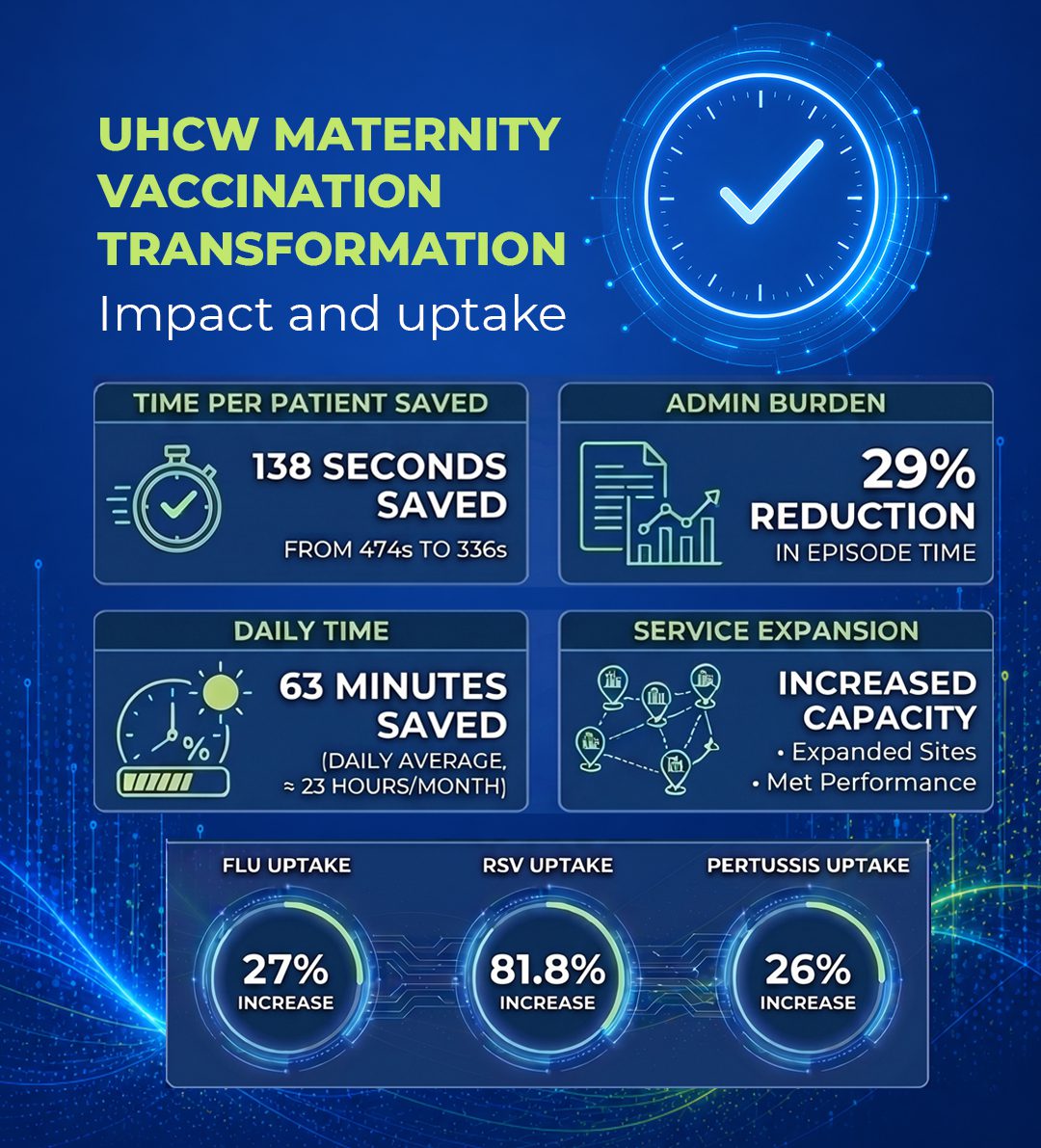
Measurable operational impact
A formal time‑and‑motion review conducted by the maternity team, demonstrated the impact of the new workflow:
- 138 seconds saved per patient (from 474 to 336 seconds)
- 29% reduction in time spent per episode
- Equivalent to 63 minutes saved per day and 23 hours per month
Importantly, all of this time was saved from nurse documentation and administration and not patient contact.
For vaccinators, this has meant more consistency and confidence throughout the day. “The clinics feel much more organised now,” said McBride. “We’re able to focus on the patients in front of us rather than spending time managing paperwork or trying to predict demand.”
“Patient clinical time hasn’t changed,” said Hands. “What we’ve gained is more time to talk to women about vaccines, answer questions, and promote other vaccinations.”
These efficiencies enabled the service to increase capacity, expand across sites, and meet and exceed performance thresholds.
Transforming vaccination uptake
Alongside operational gains, Swiftqueue has had a clear impact on vaccination uptake across all three maternal vaccination programmes between 2024/25 and 2025/26:
- 27% increase in flu vaccination uptake
- 8% increase in RSV vaccination uptake
- 26% increase in whooping cough (pertussis) vaccination uptake
These improvements coincided with wider national efforts to increase maternal vaccination uptake, including the Department of Health and Social Care and UKHSA’s Stay Strong, Get Vaccinated campaign. However, UHCW’s results most significant improvements were seen following the expansion of the service and the introduction of Swiftqueue, which helped make appointments more accessible and flexible for women across the region. “Normally when flu season starts, we see a dip in uptake for other vaccines,” Hands noted. “This time, all three increased — which was a big shift for us.”
The service exceeded its contractual targets, securing additional funding that has since been reinvested into further improvements, including self-service check-in kiosks and iPads. The funding has also helped ensure Swiftqueue can remain part of the service’s long-term delivery model. “It’s all cycled really well,” said Hands. “We’ve improved patient experience, hit targets, and earned funding that allows us to continue using Swiftqueue.”
Supporting wider NHS priorities
The need for accessible maternity vaccination services remains significant. Nationally, flu vaccination uptake among pregnant women was 38.4% in the 2025/26 season, highlighting the ongoing challenge of ensuring women can access vaccination during pregnancy. For RSV, timing matters as much as availability. UKHSA’s evaluation of 289,399 found vaccine effectiveness of 81.3% when administered at least 14 days before birth, rising to almost 85% when given more than four weeks before delivery.
At the same time, uptake continues to vary considerably across different populations and communities, reinforcing the importance of reducing practical barriers to access and delivering vaccinations through trusted maternity services. The Swiftqueue model implemented at UHCW aligns closely with NHS and UKHSA priorities around improving maternal vaccination uptake, reducing inequalities, and delivering care in digitally enabled, paper‑light ways.
By offering vaccinations within maternity settings, the service has also reduced pressure on GP practices. “We’re not sending fit, healthy pregnant women to GP surgeries anymore,” said Hands. “They’re getting vaccinated where they already attend for antenatal care and GPs have noticed the difference.”
The impact has also been visible at the point of care. According to McBride, easier access and clearer appointment pathways help create a smoother experience for women attending vaccination appointments. “Anything that makes it easier for women to access vaccination is a positive step. Having a system that helps us manage appointments and support patients more effectively has made a real difference to the service.”
Looking ahead
Over the next 12 to 24 months, UHCW plans to build on this foundation by increasing the proportion of pre‑booked appointments, introducing self check‑in kiosks, and extending Swiftqueue to additional services such as BCG vaccination for newborns.
“For families, it’s about familiarity,” said Hands. “They’ve booked their maternity vaccines this way and so when their baby needs a BCG appointment, it feels natural and easy.”
As the service continues to evolve, Swiftqueue will remain a core enabler, supporting flexible, patient‑centred maternity vaccination services at scale, and helping turn access into uptake.
Customer Quotes
Charlotte Hands
Public Health Specialist Midwife, UHCW« We needed something user‑friendly. We serve a really mixed demographic, including different levels of deprivation, language barriers and digital confidence. Accessibility was a big factor for us. »
Deborah McBride
Vaccination Nurse, UHCW« The clinics feel much more organised now. We’re able to focus on the patients in front of us rather than spending time managing paperwork or trying to predict demand. »
Charlotte Hands
Public Health Specialist Midwife, UHCW« What we’ve gained is more time to talk to women about vaccines, answer questions, and promote other vaccinations. »
Discover Swiftqueue
Click to learn more about Swiftqueue – the complete enterprise scheduling platform for healthcare